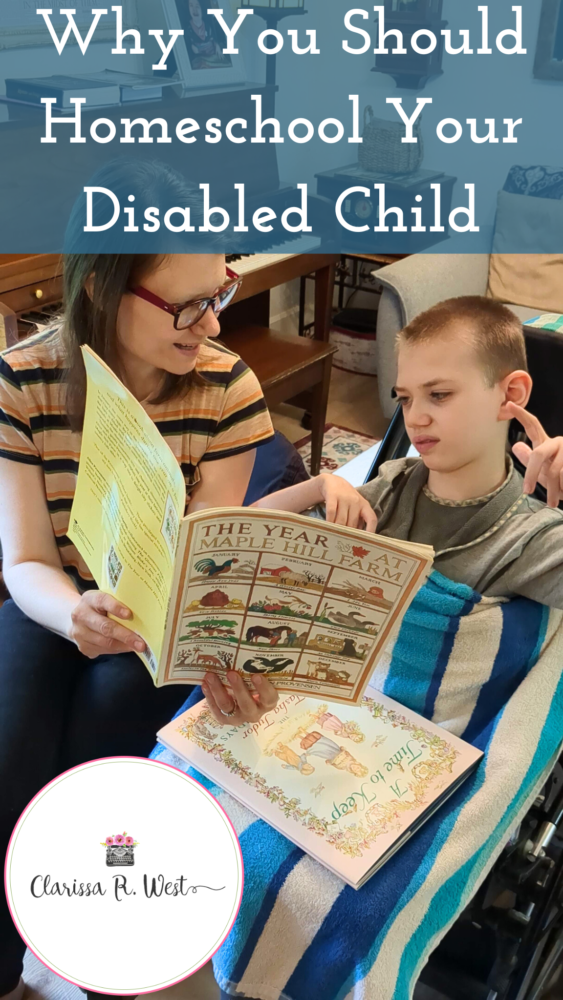
There are a lot of reasons why you should homeschool your disabled child. Let me share them with you.
I have eight children, and two of my children were born with a condition that causes severe global developmental delays, including intellectual delays. My eldest daughter was born in 2006, and my youngest son was born in 2014, each with the debilitating and terminal diagnoses. I have homeschooled all of my children (my eldest son was born in 2005, so you could say that is when our home education journey began); their abilities or disabilities never interfered with that choice, other than to strengthen it. One of the benefits of homeschooling has always been the ability to adapt to your child’s needs, customize their education, and cultivate an atmosphere of love and security. Therefore, I advocate for homeschooling your children, even/especially if they are disabled.
I believe you are your child’s best advocate – you know what is best for them! The reasons why you should homeschool your disabled child are very similar to the reasons why you should homeschool your typically developing children. In fact, I would say you have even greater reasons to homeschool disabled children – these are what I outline below.
I am writing this article to give you the reasons why you should homeschool your disabled child, with a desire to encourage and empower you if you have found yourself in this position. This is my opinion based on my experiences, and I understand that others may have drastically different opinions or experiences.
(additional reading: HOW to Homeschool Your Disabled Child)
Sunshine & Blue: A Book About Special Children A Wheelchair for FrancisA Meaningful Life Journal For Moms: Prayers & Plans to help you organize your life & develop good habitsAll About Teaching Language Arts For Homeschool MomsAll of the Reasons Journal: 52 biblical word studies for homeschool moms


Why you should homeschool your disabled child:
- If they have a limited ability to communicate (if they are nonverbal, as my children are), the need for you to protect them is super important. A child who cannot tell you anything about their time away from you should be left with a very limited number of highly vetted individuals whom you trust immensely. Whew! That seems like a high standard to hold, but I can’t stress this enough – they should never be left in the care of others for most of their day/life! I have read too many news stories about disabled/non-verbal children being abused. This is one of my top reasons for homeschooling my disabled children.
- Their needs are even greater than those of a typically developing child; therefore, they need you to be present as much, or more than a healthy child does. For example, my children are in diapers, have feeding tubes, and require 24/7 supervision because of chronic vomiting, so I know that nobody else would give them the care and attention they need to survive.
- If they are intellectually delayed, then you must consider whether you would send any child at their “developmental age” to school. My disabled children are at an infant/toddler developmental level, so regardless of anything else, I would not send my infant/toddler to school. When our eldest daughter was approaching school age, our pediatrician asked if I would send her to school. I asked the doctor what our fully disabled (infant-like) daughter would do at school – she said she would be played with using toys/activities appropriate for her developmental level, and cared for by a Special Education Aid that would be assigned to her. I said, “We do all of that and more with her at home.” (The doctor then suggested I send her to “get a break”, but I am a homeschool mom, so we all know that’s not how I operate.)
- A disabled child will actually learn (as much as they possibly can) at home, surrounded by the people they love. My disabled children have not been isolated in a special education class to sit in their wheelchairs amongst other disabled children, with their teachers going through the motions of “playing with them” for several hours each day. No, my disabled children are surrounded by an active, busy, loud, interactive family. They are surrounded by several typically developing children who are receiving an education and are read out loud to by mom (me) every day. My disabled children have received a well-rounded education based on what their siblings are learning, via auditory, visual, and observational means. They are immersed in an educational atmosphere, though they may not express exactly what they were taught due to their communication limitations.
- Disabilities often come with other health concerns, such as fragile immune systems. My children have compromised immune systems, and catching the common cold can turn deadly for them. Rather than gaining a stronger immune system through exposure, they would be sick, miserable, and hospitalized. After years of spending weeks in the hospital fighting colds that turned into pneumonia or dehydration, we realized that our eldest daughter was too fragile to bring to church or family gatherings regularly. Once we limited her exposure, she became much healthier. Our youngest son was born around the time that we started limiting our family’s exposure to viruses, and he has only been hospitalized for a couple of days for one illness. Homeschooling helps protect compromised immune systems.
- If they have a life-threatening disability, then you will miss every moment you did not share with them when/if they pass away. Our eldest daughter passed away at the age of 14. I am so thankful that I homeschooled her and spent nearly every day of her life with her. The joy and memories that I have are cherished beyond words.
In Conclusion
I have had the unique perspective of having lived through caring for and losing one disabled child while also caring for and raising another disabled child. I gave my eldest daughter the best life I could, but now I can take all that I learned from her and apply it towards giving my youngest child the best life. Sharing what I have learned with other parents of a disabled child is what I’m here for! The goal is quality of life. For children of all abilities, that means being surrounded by the ones they know and love most – their family. I know the sacrifice it requires, but I promise it is worth it – they are worth it.
P.S. I am not discrediting outside help/therapy for your disabled child. Still, I do recommend always being present with your child for every session, especially until you know the person well.
You Might Also Like …
HOW to Homeschool Your Disabled Child
Written in honor of my youngest child, Jubal, and in memory of my oldest daughter, Abigail – both blessings who taught me more than I could have ever taught them!

Thank you so much for this. I have spent the last couple of years scouring the internet for how people homeschool their severely disabled children and there is SO LITTLE out there. Most are for kids who either are still ambulatory but intellectually disabled or they are only physically disabled. Mine is both. This is helpful!
I’m so glad you found this helpful.
I am saying a prayer for you! ❤️